.png)
What Is the Difference Between Legal and Non-Legal DNA Testing?
- Steve Stoutenberg, RN
- Jun 5
- 4 min read
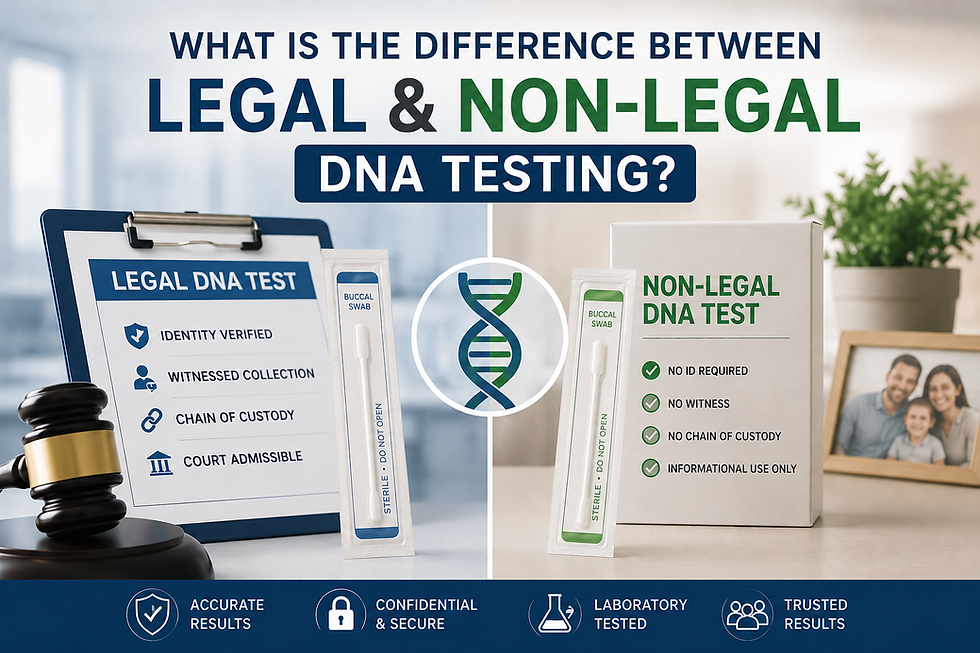
When considering a DNA test, one of the most common questions people ask is whether they need a legal DNA test or a non-legal DNA test. While both tests use the same laboratory technology and can provide highly accurate results, the way the samples are collected and documented determines whether the results can be used in court or for personal knowledge only.
Understanding the difference can help you choose the right test for your situation and avoid paying for services you may not need.
Understanding DNA Testing
DNA testing analyzes genetic material to determine biological relationships between individuals. DNA tests are commonly used for:
Paternity testing
Maternity testing
Sibling relationship testing
Grandparent testing
Avuncular testing (aunt/uncle relationships)
Immigration-related testing
Personal knowledge and family verification
The primary difference between legal and non-legal testing is not the science behind the test. The difference lies in the collection process and how the samples are documented.
What Is a Non-Legal DNA Test?
A non-legal DNA test, often called a "peace of mind" DNA test, is performed for informational purposes only.
Individuals seeking answers about biological relationships often choose a non-legal DNA test because it is typically less expensive, more convenient, and faster to arrange.
Common Reasons for Non-Legal DNA Testing
People may choose a non-legal DNA test when they want to:
Confirm paternity for personal knowledge
Verify family relationships
Resolve family questions privately
Gain peace of mind before pursuing legal action
Learn more about biological connections
How Non-Legal DNA Testing Works
In a non-legal DNA test:
Participants collect their own DNA samples or have samples collected without formal witness procedures.
Identification documents are generally not required.
There is no chain-of-custody documentation.
Samples may be collected at home using a DNA collection kit.
Once the samples are submitted to the laboratory, they are analyzed using the same scientific methods used for legal testing.
Important Limitation
Although the laboratory results may be highly accurate, non-legal DNA test results cannot typically be used as evidence in court because there is no verified documentation proving who provided the samples.
What Is a Legal DNA Test?
A legal DNA test follows a strict chain-of-custody process designed to verify the identity of all participants and maintain the integrity of the samples.
Because of these additional safeguards, legal DNA testing results can be used in legal and governmental proceedings.
Common Reasons for Legal DNA Testing
A legal DNA test may be required for:
Child custody cases
Child support proceedings
Family court matters
Birth certificate amendments
Inheritance disputes
Probate cases
Immigration matters
Adoption-related proceedings
Social Security benefit claims
How Legal DNA Testing Works
The legal DNA testing process includes:
Identity Verification
Each participant must provide government-issued identification before the sample is collected.
Witnessed Collection
A trained and authorized collector observes the collection process to ensure the samples are obtained from the correct individuals.
Chain of Custody Documentation
Detailed records are maintained throughout the entire process, documenting:
Participant identities
Collection dates and times
Sample handling procedures
Laboratory receipt and processing
Secure Laboratory Procedures
The samples are transported and processed under strict protocols to ensure accuracy and admissibility.
Court-Admissible Results
Because the identities of the participants and the handling of the samples are documented and verified, legal DNA test results may be accepted by courts and government agencies.
Which Test Is More Accurate?
One of the biggest misconceptions about DNA testing is that legal tests are more accurate than non-legal tests.
In reality, both tests are typically analyzed using the same accredited laboratory technology and scientific methods.
The accuracy of the relationship determination is generally the same.
The difference is that legal DNA testing includes documented procedures that establish the authenticity of the samples and the identity of the participants.
Legal vs. Non-Legal DNA Testing at a Glance
Feature | Legal DNA Test | Non-Legal DNA Test |
Court Admissible | Yes | No |
Identity Verification Required | Yes | No |
Chain of Custody Documentation | Yes | No |
Witnessed Collection | Yes | No |
Personal Knowledge Purposes | Yes | Yes |
Court or Government Use | Yes | No |
Home Collection Available | Typically No | Often Yes |
How Do You Know Which Test You Need?
You should consider a legal DNA test if:
A court has requested testing.
You are involved in a child support case.
You need results for custody proceedings.
You are seeking immigration benefits.
You plan to use the results in a legal matter.
A non-legal DNA test may be appropriate if:
You simply want personal answers.
You are confirming a biological relationship privately.
No court or government agency requires the results.
You are seeking peace of mind.
If there is any possibility that the results may be needed for legal purposes in the future, it is often best to choose a legal DNA test from the beginning.
Why Choosing a Professional Collection Site Matters
Working with a professional DNA testing provider helps ensure that the testing process is completed correctly from start to finish.
An experienced collection site can:
Verify proper documentation requirements
Explain testing options
Coordinate with accredited laboratories
Maintain chain-of-custody procedures when required
Answer questions throughout the process
Choosing the correct type of DNA test from the beginning can save time, money, and unnecessary delays.
Ready to Schedule a DNA Test?
Whether you need a court-admissible legal DNA test or a non-legal test for personal knowledge, our team is here to guide you through the process with professionalism, confidentiality, and care.
Contact Summit Screening Services today to schedule your DNA test or learn more about which testing option is right for your situation.
Comments